Pulling Together
About this resource
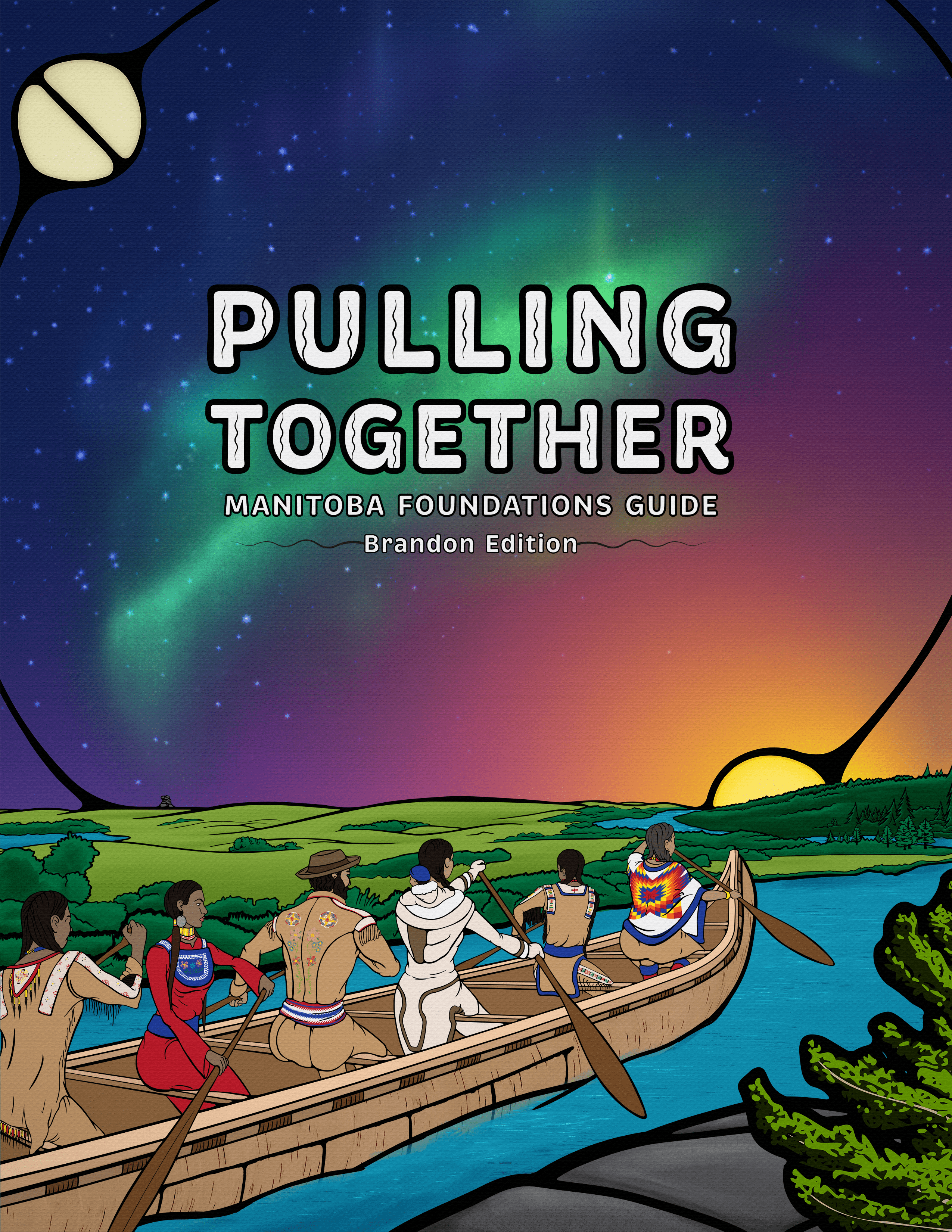
The Manitoba Foundations Guide (Brandon Edition) is the first Manitoba adaptation of an open professional learning series developed for staff across post-secondary institutions. This guide is an adaptation of the Foundations Guide published by BCcampus and the Ministry of Advanced Education. This guide explores Indigenous-Canadian relationships from contact to the present in order to support the systemic change occurring across post-secondary institutions and beyond through Indigenization, decolonization, and reconciliation. This guide looks at the diversity of Indigenous Peoples and the historical and contemporary realities since contact. It may be a first step or guide to becoming involved in conversations about these important topics.
- Authors
- Manitoba Foundations Group
- Published
- 2021
- License
- CC BY-NC 4.0, except where otherwise noted
- Attribution
- Pulling Together by Manitoba Foundations Group is licensed under a CC BY-NC 4.0 license.
- Topics
- Indigenization
License
This resource is licensed under a Creative Commons Attribution-NonCommercial 4.0 International License.
You may:

Share
You may copy and redistribute the material in any medium or format.

Adapt
You may remix, transform, and build upon the material for any purpose, even commercially.
The licensor cannot revoke these freedoms as long as you follow the license terms.
As long as you follow these terms:

Give credit
You must give appropriate credit, provide a link to the license, and indicate if changes were made. You may do so in any reasonable manner, but not in any way that suggests the licensor endorses you or your use.

Don't use commercially
You may not use the material for commercial purposes.
No further restrictions
You may not apply legal terms or technological measures that legally restrict others from doing anything the license permits.
Other things to know:
- The licensor cannot revoke these freedoms as long as you follow the license terms.
- You do not have to comply with the license for elements of the material in the public domain or where your use is permitted by an applicable exception or limitation.
- No warranties are given. The license may not give you all of the permissions necessary for your intended use. For example, other rights such as publicity, privacy, or moral rights may limit how you use the material.
Frequently Asked Questions
How do I use OER from this collection?
1. Search the collection.
Find matching OER based on subject area, course level, institution course codes (e.g., UBC MATH 101), or keywords. The collection has highly curated materials, so if you don’t find what you are looking for, you can search other OER repositories such as OASIS, which will return many resources not reviewed by BCcampus.
2. Evaluate.
Decide whether the materials will suit your needs as they are, or if they could be customized to fit your course. Some features that may help you narrow down your search are seeing if the resource has supplementary teaching materials, is accessible, is for the right level, or has been tried and tested by peers in the field.
3. Customize.
You may find you want to customize the materials for your course. Download the editable formats to make changes according to the license. For more information on how to customize or adapt open educational resources (OER) see the BCcampus Adaptation Guide.
4. Distribute to your students.
You can download the resource in the different available formats and share using your favourite platforms, including a learning management system or file-sharing service like Dropbox or Google Drive.
5. Inform us.
Fill out the Open Textbook Adoption Form or Open Course Materials Adoption Form so we can help others see that colleagues are adopting OERs.
Do I need permission to use materials from this collection?
What can I do with materials under open or Creative Commons licenses?
An open license, or open-copyright license, grants permission to access, retain, reuse, redistribute, and build on (remix and revise) a work with few or no restrictions.
The terms of open or Creative Commons licenses vary; however, all Creative Commons licences contain an attribution (BY) clause. This means you must include a statement that gives credit to, or attributes, the creator of the work from which you have borrowed, whether it’s text, image, video, or another item. If you have made a change, indicate that in your attribution statement.
For more information, see “Attribution Statement” in the Adaptation Guide.
How do I customize materials from the collection?
You may find you want to customize the materials for your course. Because all of the materials in this collection are openly licensed, you are free to adapt and reuse them. Open licences are how copyright holders let the world know that they are okay with people taking, reusing, and adapting their creative works.
To adapt the materials in this collection, download the editable formats to make changes according to the license.
See the sections on Licences and Permissions in the Getting Started: OER Publishing at BCcampus guide for more information.
Once changes are made, ensure that you:
- Follow the license requirements, such as giving credit to the original creator
- Keep track of the changes that were made
For more information on how to customize or adapt open educational resources (OER) see the BCcampus Adaptation Guide.
How do I report an issue with materials?
If you encounter an error or inappropriate content on the site or in any of the course materials, please contact us so the issue can be resolved.
What's the best way to find course packs for my course?
If you are teaching a course at a B.C. institution, the easiest way to see if there is a course pack for your course (or transferable equivalent) is to search by course code. For example, typing TRU ECON 2320 will show you Business Statistics, which was designed for MATH 125 at Coast Mountain College.