Navigating the Waters of Leadership Education in Indigenous Contexts
About this resource
By Valeria Cortés, associate faculty, Royal Roads University
About the Study
This study builds on two years of research investigating the impact of the Professional Project Administrator Program (PPA), which is offered by Royal Roads University in partnership with Indigenous communities. The arts- and participatory-based research, conducted with six different cohorts of Indigenous students in B.C. and Alberta, revealed that the Collective Leadership course had a profound impact on many learners due to its focus on Indigenous Knowledges (Cortés et al., 2024).
The purpose of the study is to better understand leadership education, training, and development delivered by Canadian post-secondary education institutions to Indigenous partners/communities, as well as to investigate curricular and pedagogical practices that contextualize Indigenous languages, cultures, and relationship with the land, centering relationality as a guiding principle in education.
Research Methodology
Guided by an Indigenist approach and the notion of *co-razonar (thinking together with the heart), the study will use a mixed methods approach where participants engage in storytelling and visual narratives to provide a deep understanding of the educator’s journey.
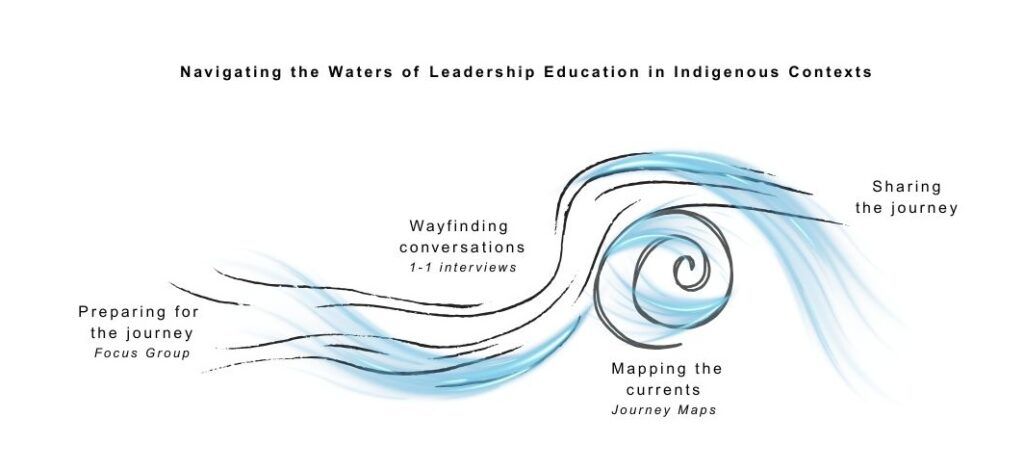
The research process consists of four interconnected phases.
Preparing for the journey focuses on relationship building and identifying the needs of educators who teach leadership in Indigenous contexts.
Wayfinding conversations entails engaging in one-on-one conversations with educators who are interested in sharing their experience in more depth.
Mapping the currents refers to visualizing ways in which educators navigate the currents of leadership education, training, and development.
Sharing the journeyfocuses on sharing the research findings.
Why is This Study Important for Post-Secondary Education?
Navigating the Waters aims to contribute to the literature on relational pedagogies. By exploring the pedagogical elements, complexities, and relationships that exist when delivering (leadership) courses in Indigenous contexts, I hope we can become better prepared to implement culturally relevant teaching methods grounded in relationality and accountability.
Most importantly, the findings will deepen educators’ understanding of what is needed to offer courses that enable Indigenous learners and communities to restore knowledge systems through culturally relevant practices that reconnect with language, land, and culture. Finally, the exploration of Indigenist research methodologies like co-razonar, as well as arts-based methods, will contribute to expanding the plurality of knowledge systems in post-secondary education.
What Do I Hope to Learn?
I am interested in the role of relationality in the learning space. I wonder about the interwoven understanding of land, language, and culture in educational programming, particularly in ways that honour and sustain relational ways of knowing, thinking, and being. I hope to learn from and with those who are engaged in this work; to listen to their stories and the practices that are reshaping educational spaces. I hope to contribute to shared learning where post-secondary educators and Indigenous communities/partners co-create leadership programming that is culturally relevant and contextualized.
You can listen to an AI-generated audio summary of this research project. The audio was generated via NotebookLM by uploading the research proposal I wrote for the project. This is a choice I am making to better understand this tool and to share it in this context. We still need to think about how the algorithm is putting out my information in this format without a relational ethic or reciprocity (the irony is not lost on me). Let’s continue approaching these tools with awareness.
Footnote
*Co-razonar
Corazón=heart
Razonar=to reason
Co-razonar turns the Spanish word for heart into a verb giving it a second meaning related to reasoning. It means the collective act of reasoning with the heart (Albarrán, 2022). Co-razonar has been used as research methodology to access embodied, wholistic knowledge rather than disembodied intellectual knowledge (Rojas-Zambrano, 2023).
Learn More
Indigenous Leadership Education: Navigating Decolonization (audio)
2024-2025 BCcampus Research Fellows
2024–2025 BCcampus Research Fellow: Valeria Cortes
References
Albarrán González, D. (2022). Corazonar: Weaving values into the heart of design research. Proceedings of the Participatory Design Conference, USA, (2), 33-38.
Cortés, V., Brigham, T., Loffler, K., & Schlattner, C. (2024). Transforming online teaching
through relational ways of being. Papers on Post-secondary Learning and Teaching, 7, 17-29.
Rojas-Zambrano, P. (2023). Decolonizing mental health through HE/A/R/TOGRAPHY:
CORAZONAR, SENTIPENSAR Y SENTISABER. (Doctoral dissertation, University of San Francisco)
- Authors
- Valeria Cortes
- Published
- April 23, 2025
- Attribution
- Navigating the Waters of Leadership Education in Indigenous Contexts by Valeria Cortes
Frequently Asked Questions
How do I use OER from this collection?
1. Search the collection.
Find matching OER based on subject area, course level, institution course codes (e.g., UBC MATH 101), or keywords. The collection has highly curated materials, so if you don’t find what you are looking for, you can search other OER repositories such as OASIS, which will return many resources not reviewed by BCcampus.
2. Evaluate.
Decide whether the materials will suit your needs as they are, or if they could be customized to fit your course. Some features that may help you narrow down your search are seeing if the resource has supplementary teaching materials, is accessible, is for the right level, or has been tried and tested by peers in the field.
3. Customize.
You may find you want to customize the materials for your course. Download the editable formats to make changes according to the license. For more information on how to customize or adapt open educational resources (OER) see the BCcampus Adaptation Guide.
4. Distribute to your students.
You can download the resource in the different available formats and share using your favourite platforms, including a learning management system or file-sharing service like Dropbox or Google Drive.
5. Inform us.
Fill out the Open Textbook Adoption Form or Open Course Materials Adoption Form so we can help others see that colleagues are adopting OERs.
Do I need permission to use materials from this collection?
What can I do with materials under open or Creative Commons licenses?
An open license, or open-copyright license, grants permission to access, retain, reuse, redistribute, and build on (remix and revise) a work with few or no restrictions.
The terms of open or Creative Commons licenses vary; however, all Creative Commons licences contain an attribution (BY) clause. This means you must include a statement that gives credit to, or attributes, the creator of the work from which you have borrowed, whether it’s text, image, video, or another item. If you have made a change, indicate that in your attribution statement.
For more information, see “Attribution Statement” in the Adaptation Guide.
How do I customize materials from the collection?
You may find you want to customize the materials for your course. Because all of the materials in this collection are openly licensed, you are free to adapt and reuse them. Open licences are how copyright holders let the world know that they are okay with people taking, reusing, and adapting their creative works.
To adapt the materials in this collection, download the editable formats to make changes according to the license.
See the sections on Licences and Permissions in the Getting Started: OER Publishing at BCcampus guide for more information.
Once changes are made, ensure that you:
- Follow the license requirements, such as giving credit to the original creator
- Keep track of the changes that were made
For more information on how to customize or adapt open educational resources (OER) see the BCcampus Adaptation Guide.
How do I report an issue with materials?
If you encounter an error or inappropriate content on the site or in any of the course materials, please contact us so the issue can be resolved.
What's the best way to find course packs for my course?
If you are teaching a course at a B.C. institution, the easiest way to see if there is a course pack for your course (or transferable equivalent) is to search by course code. For example, typing TRU ECON 2320 will show you Business Statistics, which was designed for MATH 125 at Coast Mountain College.