Understanding Ingredients for the Canadian Baker
About this resource
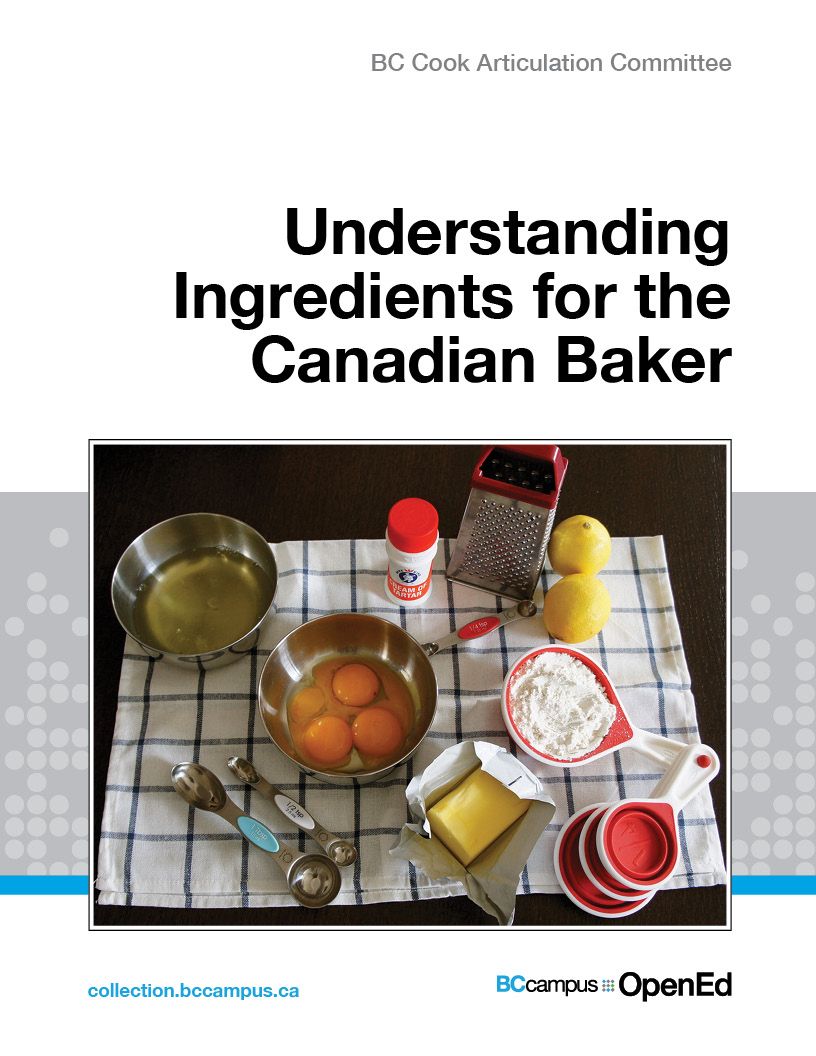
This book is intended to give students a basic understanding of the various types and uses of ingredients used in the baking industry, and how certain ingredients, in particular grains and flours are produced, graded and processed in Canada. Understanding Ingredients for the Canadian Baker is one of a series of Culinary Arts books developed to support the training of students and apprentices in British Columbia’s food service and hospitality industry. Although created with the Professional Cook and Baker programs in mind, these have been designed as a modular series, and therefore can be used to support a wide variety of programs that offer training in food service skills.
Other books in the series include:
- Food Safety, Sanitation, and Personal Hygiene
- Working in the Food Service Industry
- Workplace Safety in the Food Service Industry
- Meat Cutting and Processing
- Human Resources in the Food Service and Hospitality Industry
- Nutrition and Labelling for the Canadian Baker
- Basic Kitchen and Food Service Management
The series has been developed collaboratively with participation from public and private post-secondary institutions.
- Authors
- BC Cook Articulation Committee and go2HR
- Published
- October 23, 2015
- License
- CC BY 4.0, except where otherwise noted
- Attribution
- Understanding Ingredients for the Canadian Baker by BC Cook Articulation Committee and go2HR is licensed under a CC BY 4.0 license.
Contents
| Name | Material Type | File Type | File Size | Access | License |
|---|---|---|---|---|---|
| Versioning history | Other | Read online | - | View material | |
| Accessibility statement | Other | Read online | - | View material | |
| FIND: Culinary Arts series | Other | - | - | View material |
License
This resource is licensed under a Creative Commons Attribution 4.0 International License.
You may:

Share
You may copy and redistribute the material in any medium or format.

Adapt
You may remix, transform, and build upon the material for any purpose, even commercially.
As long as you follow these terms:

Give credit
You must give appropriate credit, provide a link to the license, and indicate if changes were made. You may do so in any reasonable manner, but not in any way that suggests the licensor endorses you or your use.
Other things to know:
- The licensor cannot revoke these freedoms as long as you follow the license terms.
- You do not have to comply with the license for elements of the material in the public domain or where your use is permitted by an applicable exception or limitation.
- No warranties are given. The license may not give you all of the permissions necessary for your intended use. For example, other rights such as publicity, privacy, or moral rights may limit how you use the material.
Frequently Asked Questions
Do I need permission to use materials from this collection?
What can I do with materials under open or Creative Commons licenses?
An open license, or open-copyright license, grants permission to access, retain, reuse, redistribute, and build on (remix and revise) a work with few or no restrictions.
The terms of open or Creative Commons licenses vary; however, all Creative Commons licences contain an attribution (BY) clause. This means you must include a statement that gives credit to, or attributes, the creator of the work from which you have borrowed, whether it’s text, image, video, or another item. If you have made a change, indicate that in your attribution statement.
For more information, see “Attribution Statement” in the Adaptation Guide.
How do I report an issue with materials?
If you encounter an error or inappropriate content on the site or in any of the course materials, please contact us so the issue can be resolved.
I want to offer print copies to my students. Is that allowed?
Yes!
If you wish to make print copies of your book available, check with your institutional print shop to see if they have the ability to create print versions of the textbook on site for your students. Many institutional print shops can create low-cost printed versions of textbooks and make them available to students.
Keep in mind...
that textbooks that have a specific non-commercial clause (CC BY-NC) cannot be sold with a markup or at a profit. However, charging a cost-recovery fee for print textbooks is acceptable.
How do I become a reviewer for a book?
BCcampus is looking for qualified textbook reviewers from British Columbia, Alberta, Saskatchewan, and the Yukon to review existing open textbooks in the B.C. Open Textbook Collection. We accept open textbook review applications from post-secondary instructors in these regions who have teaching experience in the relevant subject area. This includes Ph.D. candidates who have completed their qualifying exams and are involved in teaching.
Faculty interested in reviewing an open textbook in the B.C. Open Collection should submit an application form. See "Review a textbook" page for more information.