Choose Your Own Adventure! A Look Back at the Interactive Kickoff to the EdTech Sandbox Series
By Sana Jamil, Educational Technologist, University Canada West and Gabriela Kurtz, Assistant Professor, School of Communication, University of the Fraser Valley
On September 10, 2025, we had the pleasure of launching the 2025-2026 BCcampus EdTech Sandbox Series with our interactive workshop Choose Your Own Adventure! Dynamic Branching Scenarios and Game Maps with H5P and AI Tools. The EdTech Sandbox Series is designed to introduce and demonstrate cutting-edge, open, and free or low-cost educational technology tools that align with the B.C. Post-Secondary Digital Literacy Framework.
In our 90-minute, hands-on session, we welcomed a diverse group of post-secondary educators from across Canada. Together, we explored how H5P branching scenarios and game maps, enhanced by AI tools, can foster immersive, learner-driven experiences. These tools support:
Active learning
Formative assessment
Personalized learning pathways
As part of the session, participants engaged in:
Creating H5P accounts and exploring the platform
Designing branching scenarios and game maps using AI-generated content
Showcasing their prototypes in real time
Spotlight on H5P Tools
Game Maps
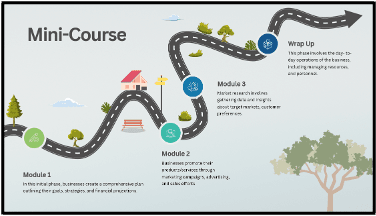
Game maps allow educators to design gamified learning paths where learners unlock content by completing tasks or answering questions. Applications include:
Module-based learning
Scenario-based training
Research skill development
Orientation/onboarding
Review and assessment
Tips for effective use:
Narrative: embed a compelling story or theme
Feedback: offer instant, informative feedback
Multimedia: enrich with videos, images, and audio
Progress tracking: Support self-paced learning with visible indicators
Branching Scenarios
Branching scenarios enable educators to create interactive, story-driven experiences where learners make decisions and explore consequences in a safe, simulated environment. They are ideal for:
Ethics training
Business dilemmas
Health-care decision making
Crisis communication
Policy navigation
These scenarios promote engagement, reflection, and assessment of complex real-world situations.
Streamlining the Creation Process
We introduced a three-step method to simplify the development of game maps and branching scenarios.
Step 1: Ideation with AI tools
Use generative AI (e.g., ChatGPT, Copilot, Deepseek) to draft a basic structure.
Example prompt: Create a branching scenario game script for H5P based on crisis management and public relations.
The initial draft can then be refined and customized.
Step 2: Visual planning and asset organization
Use tools like Miro or Figma to map out your activity and identify required assets (videos, questions, texts, images).
For asset creation, we recommend:
Notebook LM for generating videos and podcasts
Unsplash and Pexels for high-quality, royalty-free images and videos
Note: Always verify copyright permissions before uploading materials.
Step 3: Build in H5P
With your plan and assets ready, begin building your activity in H5P.
Explore tutorials and examples:
Participant Insights
During the session, we surveyed participants and found that most of them were familiar with H5P but had not explored the specific tools we looked at in the workshop. It was interesting to see the spectrum of professionals using it for various purposes including health, education, criminology, anthropology, human resources, business, computer science, career education, and more. Participants were surprised by how well AI can be integrated for idea generation but noted that it does have some limitations. Specifically, participants felt that the ideas and dilemmas presented by AI were overly simplistic, and that they would have to spend time making modifications to the text for it to be valuable. This reinforces the importance of having a subject matter expert create activities so that they are accurate and meaningful.
Participants were also surprised by the quality of the materials generated by the Notebook LM video and podcast features. Although the materials were not perfect and needed further editing, most participants agreed that it is a great way to streamline the asset creation process. The main limitation of this approach is related to copyright. We recommend that everyone who uses AI tools check for copyright permissions to determine if the AI-created materials can be uploaded and shared.
Final Thoughts
We extend our heartfelt thanks to BCcampus for organizing and supporting this series, and to all the educators who joined us. We’re excited to continue these conversations and look forward to future opportunities to share and learn together.
Webinar Resources and Transcript
If you missed the webinar, or want a quick refresher, you can access the webinar recordings and transcript here:
EdTech Sandbox Series: Choose Your Own Adventure! Dynamic Branching Scenarios and Game Maps with H5P and AI Tools
Related News